A female doctor uses RingCentral on her tablet

How SpineOne transforms patient access through intelligent automation

SpineOne logo
Region
Americas
Company size
20–99
Industry
Healthcare
Products used
Customer Experiences logo
AI Solutions logo
Key Metrics
2x
increase in conversion rates from calls to appointments with AI Receptionist (AIR)
66%
decrease in call abandonment rate using AIR and AI Quality Management

Overview

SpineOne faced high call abandonment due to a combination of heavy call volume and inconsistent coaching. By adopting RingCentral AI Receptionist (AIR) and AI Quality Management (AIQM), as well as RingCX for its support agents, the company stabilized coverage during staffing gaps and turned subjective "spot checks" into objective, highly detailed performance data. This shift significantly increased patient access and scheduling efficiency, and the organization plans to expand these AI solutions across its entire multi-regional network.
After just 30 days with AI Receptionist, the call abandonment rate was virtually eliminated, dropping to about 2%.
Tessa Kelley
Vice President of Operations

About our customer

SpineOne, based in Denver, has provided urgent care and rapid relief for back, neck, and joint pain as a leading multi-disciplinary rehabilitation clinic. As part of the Unity MSK network, they deliver comprehensive treatment ranging from physical therapy to advanced surgical care.

The challenge: High-pressure bottlenecks and missed connections

Managing thousands of monthly inquiries across different regions created a high-stress environment where agents were frequently overwhelmed. The reliance on manual processes and unpredictable staffing meant that many patients—often in significant physical pain—faced frustrating hold times or disconnected calls.
 
  • Saturated Market Pressure: Patients requiring urgent relief would seek competitors or ER care if phones weren't answered instantly.
  • Resource Drain: Skilled agents spent excessive time on low-value tasks, such as providing driving directions, instead of focusing on clinical scheduling.
  • Subjective Coaching: Leadership relied on random "spot checks" of recordings, leading to inconsistent training based on guesswork rather than a full view of agent performance.

The solution and ROI: AI-powered communications for patient care

To address the difficulty of managing high call volumes while maintaining empathy, SpineOne adopts a sophisticated communication ecosystem. By integrating intelligent virtual assistance with automated oversight, they provide immediate patient relief and empower their staff with transparent performance insights.
 
  • AIR slashes abandonment rates to 2% by providing 24/7 automated intake and routing, while also driving a 30% conversion rate of calls to appointments by sending direct, self-service scheduling links via SMS.
  • AI QM replaces subjective coaching with automated scorecards that analyze every interaction for tone, inflection, and accuracy.
  • RingCX consolidates diverse patient inquiries from the clinic, imaging center, and physical therapy unit into a single interface, enabling the team to handle the company’s many thousands of monthly inbound calls with improved speed and accuracy.
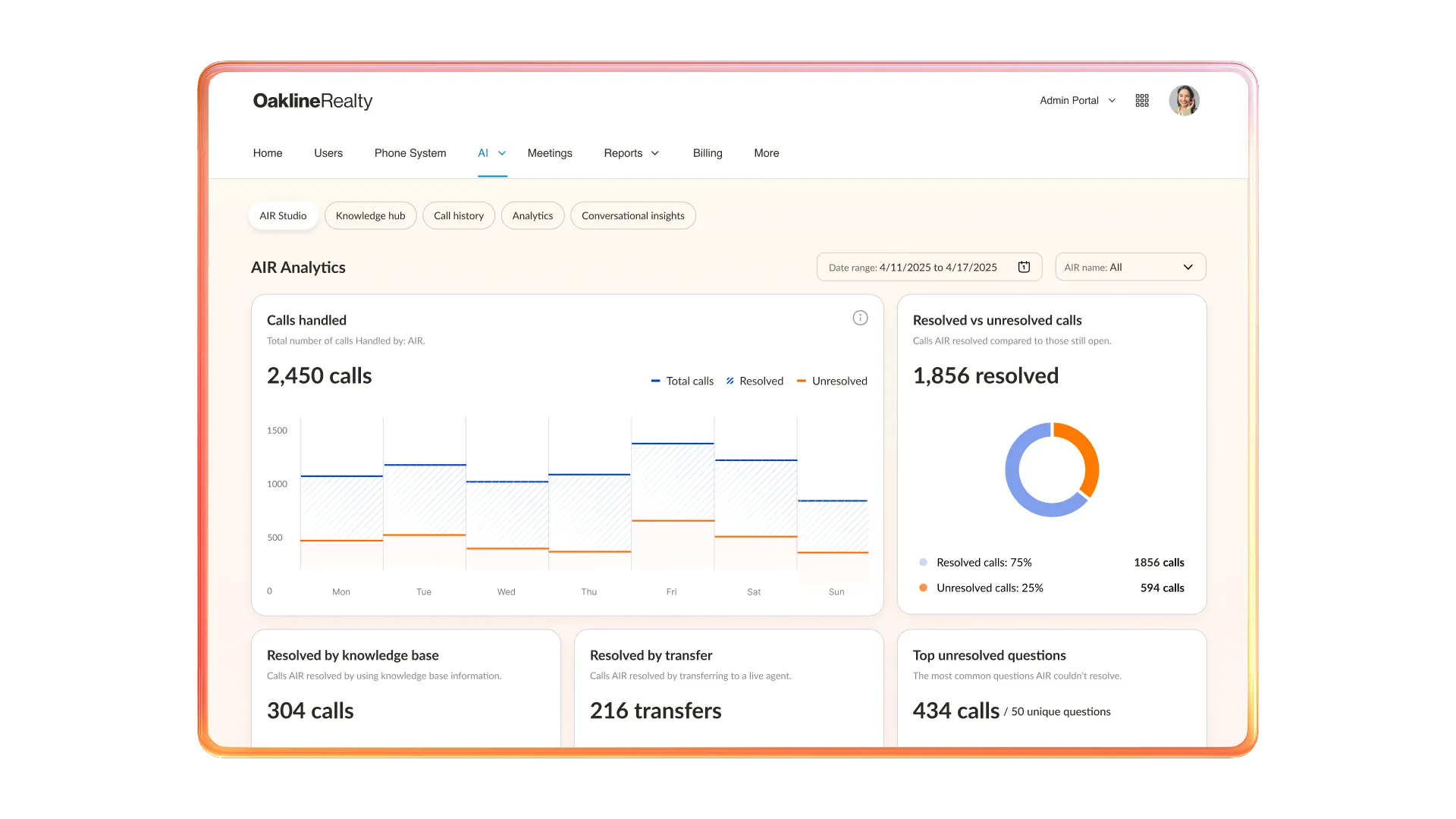
RingEX AI Receptionist dashboard showing call resolution rates, total calls handled, and top unresolved questions.

What’s next for SpineOne

The success of the company’s Denver pilot using RingCentral AIR and AI QM has established a blueprint for operational excellence that SpineOne intends to replicate across its Chicago operations and eventually the entire Unity MSK network. By unifying their communication strategy, they aim to ensure that every patient receives the same high-quality, time-sensitive care regardless of their location. This evolution from a traditional call center to an AI-enhanced patient access center secures SpineOne’s legacy as a provider that prioritizes rapid, empathetic relief through modern technology.
To learn more about our customer, visit SpineOne.